In this story
- What Makes Suzuka Circuit Different
- Suzuka Circuit Map and Layout
- The Track Layout: Key Corners and Sections
- Where the Overtaking Happens at Suzuka
- Suzuka Lap Record, Laps and Race Distance
- Main Straight and Turn 1 Grandstands
- The Esses and Hairpin Grandstands
- The Final Chicane Grandstands
- Suzuka F1 Tickets: Which Grandstand is Right for You?
- Getting to Suzuka Circuit
- Suzuka Circuit Park and Attractions
- What to Expect on Race Weekend: Weather, Hills and Practical Tips
- Join the Waitlist
Race day at Suzuka Circuit starts with a sound. It is the cars climbing into the Esses, a rising run of left and right that you hear long before you see the cars. Above the main straight the Ferris wheel turns slowly, and the grandstands fill with fans who know every corner by name. When the chequered flag falls, almost nobody hurries for the exits. The seats stay full while the track empties.
That is Suzuka F1 as it feels from the stands, and it is a different place from the one you know from television. This article takes the lap corner by corner, places every grandstand on it and spells out how far apart they are, so you can choose the right seat. It is for fans planning a trip to the Formula 1® Japanese Grand Prix, many of them for the first time.
What Makes Suzuka Circuit Different
5.807 km / 18 turns / 53 laps / 307.471 km race distance / figure-eight layout / lap record 1:30.965 (Kimi Antonelli, 2025)
Honda built Suzuka in 1962 as a test track, to a design by the Dutchman John Hugenholtz, and it is still the only figure-eight layout on the Formula 1® calendar. The track crosses over itself on an overpass, and the lap passes both under it and over it. The official name is Suzuka International Racing Course, and the circuit sits in Suzuka City, Mie Prefecture. Drivers regularly rate it among their favourites, because the lap is built on flow: long runs of fast corners with very few places to rest. It is narrow as well as fast, which is why passing here has always been hard and why a good setup before a move counts for so much.
Suzuka is also not flat. Almost every key stretch of the lap is on a slope. The Esses climb, the tight Hairpin is taken uphill, and the long run from Spoon up to 130R keeps rising. Drivers feel every change in gradient through the corners, and spectators feel it in their legs. A walk between two grandstands that looks short on the map can take far longer on foot, which is why walking times matter as much as the view when choosing a seat.
The first Japanese Grand Prix was held at Fuji Speedway in 1976, and F1® moved to Suzuka in 1987. The Suzuka race circuit has hosted every Japanese Grand Prix since except two, and our Japanese Grand Prix winners article tells the full story. Away from Formula 1®, it stays busy all year with the Suzuka 8 Hours motorcycle endurance race and Super GT.
Suzuka Circuit Map and Layout
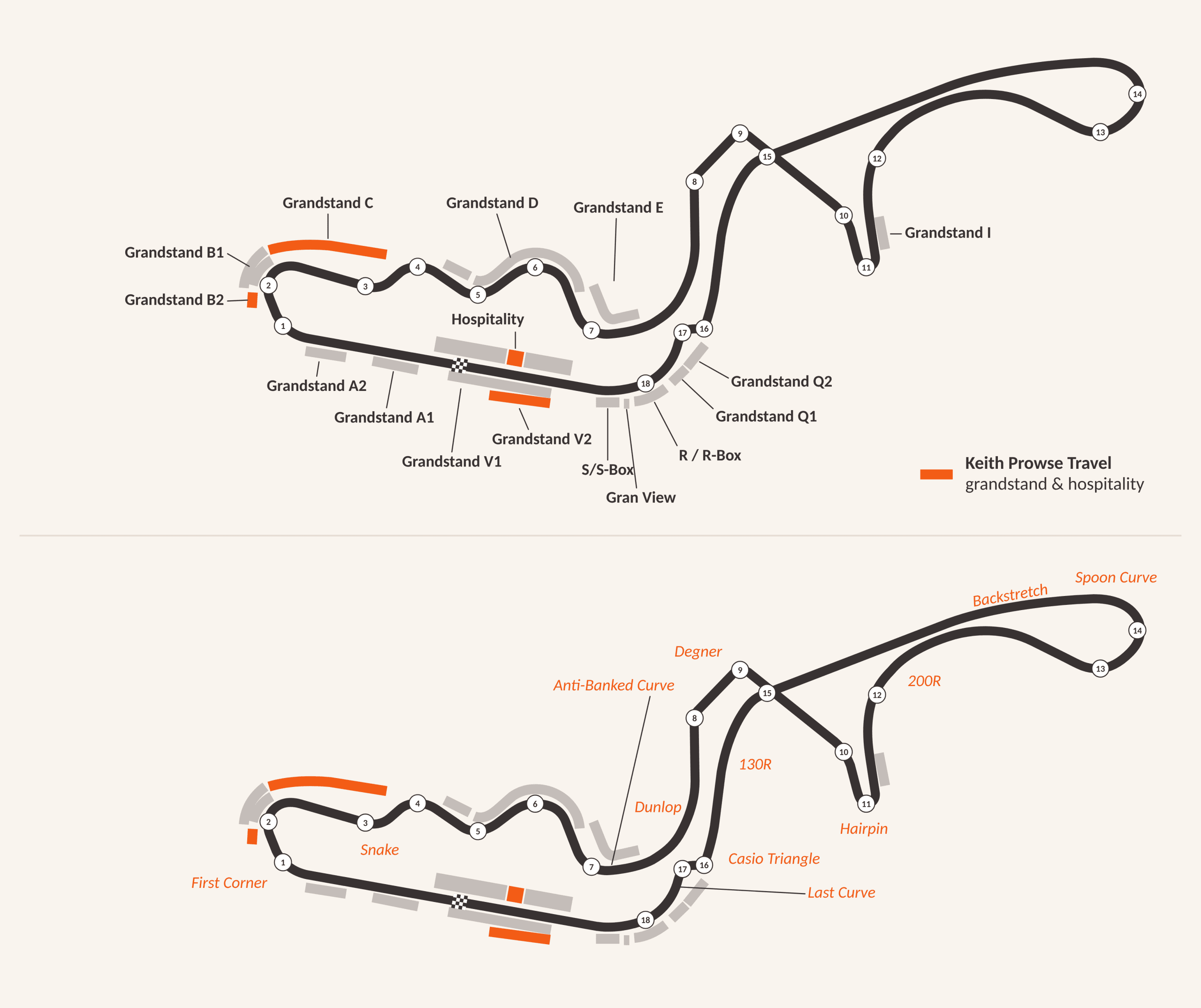
The map marks each corner by name and each grandstand by letter, and at Suzuka the names matter more than the numbers. The Esses, Degner, Spoon and 130R are as familiar to fans as Turns 1 to 18.
The figure eight is simpler than the name suggests. The back straight passes over the section of track between Degner and the Hairpin, so the lap crosses the same ground twice, once underneath and once on the overpass.
Formula 1® uses the four-wheel layout, which is 5.807 km with 18 corners. Motorcycles race on a slightly longer layout of 5.821 km with 20 corners. The circuit can also run as two separate courses, the East Course at 2.243 km and the West Course at 3.475 km.
The map also shows how the circuit divides on the ground. The main straight, pit building, Grandstands V and A, the fan zone and the Ferris wheel all sit together at one end. The Hairpin and 130R are a long walk away on the far side. That distance shapes every seating decision. The track itself is between 10 and 16 metres wide, and the East Course shows the layout in miniature, using the pit straight and the Esses before rejoining the main circuit near the Casio Triangle.
The Track Layout: Key Corners and Sections
Main Straight and Turns 1–2
The lap begins past the pits and into a fast right-hander at Turn 1 that tightens into Turn 2. From the stands you see the whole start, then the field funnelling into those first corners. It has produced some of Suzuka’s most famous moments. Senna and Prost collided here in 1990, a crash that settled the championship, and Kimi Räikkönen passed Giancarlo Fisichella for the lead on the last lap in 2005. Grandstands V, A, B and C all look onto this section.
The Esses (Turns 3–7)
Drivers rate the Esses as the heart of the lap. It is an uphill sequence of left-right changes with no reference points to lean on, so everything comes down to feel and rhythm, balancing the car on the edge through each change of direction. The sequence ends at Dunlop, Turn 7. Grandstands D and E overlook it, and what you see from there is cars flicking one way and then the other, one after another, up the slope.
Degner (Turns 8–9)
Degner is two fast, narrow right-handers with gravel close by. Carry too much speed into the first and you struggle to stop for the second, which makes it a classic mistake corner. It looks straightforward on the map and still catches drivers out.
The Crossover and the Hairpin (Turn 11)
After Degner the track passes under the overpass, then arrives at the slowest corner on the lap. Drivers brake hard for the Hairpin at Turn 11, and it has long been a traditional overtaking spot. Grandstand I sits on the exit, which is why it draws fans who come to watch passes.
Spoon (Turns 13–14)
Spoon is a long double-apex left-hander, and its exit matters more than its entry. How well a car leaves the second apex decides the run down the back straight, so drivers who pick up the throttle too early run wide and lose time. Patience here pays back in speed all the way to 130R.
The Back Straight and 130R (Turn 15)
The cars cross over the track on the back straight, then take 130R, the legendary high-speed left-hander that they drive close to flat out. It has produced some of the boldest passes in the sport. Fernando Alonso’s move around the outside of Michael Schumacher here in 2005 is the one fans still talk about.
The Casio Triangle (Turns 16–17)
The final chicane is one of the heaviest braking zones on the lap and the last test before the main straight. It was the scene of Senna and Prost’s collision in 1989. Grandstands Q, R and S sit here, and so does the detection point that matters most for overtaking under the current rules.
Where the Overtaking Happens at Suzuka
The 2026 regulations changed how passing works at Suzuka, and the change affects where fans should sit. DRS has been replaced by active aerodynamics, often called active aero. Straight Mode lowers drag on the straights automatically in dry conditions, and Suzuka has two zones: the main straight and the back straight between Turns 14 and 15.
Overtake Mode takes DRS’s place as the overtaking aid. The detection point is at Turn 17 in the Casio Triangle. A driver within one second of the car ahead there receives extra electrical power for the main straight that follows.
For anyone choosing a seat, that means the move is set up in front of Grandstands Q, R and S and completed down the main straight into Turn 1, in front of V, A, B and C. The Hairpin remains the classic late-braking spot. A pass made before Turn 1 is hard to reverse, because the Esses follow rather than another straight, so the order on the road into the first sector often holds for a while.
Suzuka Lap Record, Laps and Race Distance
The Japanese Grand Prix is 53 laps long and covers a race distance of 307.471 km. Each lap is 5.807 km, which puts the total just above the 305 km minimum that the FIA sets for a Grand Prix. When the weather stays dry, the race has generally been a two-stop affair, because the abrasive surface wears tyres quickly.
The Japanese Grand Prix lap record at Suzuka is 1:30.965, set by Kimi Antonelli in 2025. It survived the 2026 race, where the quickest lap was a 1:32.432. Official lap records count the fastest lap set in a race, which is why qualifying laps can be quicker.
| Fact | Detail |
|---|---|
| Circuit length | 5.807 km |
| Turns | 18 |
| Laps | 53 |
| Race distance | 307.471 km |
| Lap record | 1:30.965 (Kimi Antonelli, 2025) |
| Top speed | Around 328 km/h |
| First Japanese Grand Prix at Suzuka | 1987 |
Two statistics stand out. Eight of the last 12 Grands Prix at Suzuka have been won from pole position, and Michael Schumacher holds the circuit records for wins (6), poles (8) and podiums (9). Our Japanese Grand Prix winners article has the full results.
Main Straight and Turn 1 Grandstands
Grandstands V1 and V2 are the largest stands at Suzuka, in front of the pits and the starting grid, with the fan zone directly behind them. From here you see the start, the pit stops and the podium, plus Turn 1. V2 is the upper level of the Main Grandstand and sits close to the podium, and our waitlisted Grandstand V2 package includes a seat cushion. The trade-off is distance from Spoon, 130R and the Hairpin on the far side.
Grandstands A1 and A2 sit beside the V stands and look into Turn 1. The first-lap action happens right in front of you, and the 1990 and 2005 moments both played out here.
Grandstands B1 and B2 sit on the outside of Turns 1 and 2, with a view up into the first of the S curves. B2 is the grandstand in our waitlisted 7 Night Tokyo & Nagoya package, with bench seating, a cushion provided and a walk of about 10 to 15 minutes from the GP Square fan zone.
Grandstand C sits at the exit of Turns 1 and 2, running towards the S curves, and it is a common overtaking spot. It is uncovered, with two giant screens opposite. Bench seating comes with a cushion in the waitlisted Grandstand C package, and the walk to GP Square is about 15 minutes, downhill on the way in and uphill on the way out.
The Suzuka Premium Hospitality suite sits above the team garages in the Main Pit Building, overlooking the main straight. Bleacher seating in front of the suite is first come, first served, and TV screens inside carry the live feed. A grid walk and paddock tour run on Friday and Saturday only. The Suzuka Premium Hospitality package is currently on the waitlist.
The Ferris wheel beside the main grandstand has been free for ticket holders and gives views over the whole circuit. The main straight suits first-timers best, because it puts the start, the pit stops and the podium in one place.
The Esses and Hairpin Grandstands
Grandstands D and E overlook the Esses, the section drivers love most. The seats are wooden bleachers with no roof, so pack for sun and rain alike. They suit fans who want to see why Suzuka is a drivers’ favourite, watching cars change direction at speed up the slope, one after another. The Esses are also where the character of the circuit is easiest to read, because the gradient and the speed that the cars carry through it never show up properly on television.
Grandstand I sits on the exit of the Hairpin, the best spot at the circuit for late-braking overtakes and low-speed photographs. The cars rotate through almost 180 degrees here at the lowest speed of the lap. It earns its reputation on lap one, when the field arrives bunched up and positions change fastest. It is around a 30 minute walk from the main entrance, it is uncovered, and there is no big screen in view. Smaller food stalls sit nearby, so it is worth settling in early and staying put. Queues after the race can be long, so build time into the walk back.
These stands suit fans who put the racing ahead of comfort and convenience.
The Final Chicane Grandstands
Grandstands Q1 and Q2 are elevated stands at the Casio Triangle, with 130R to the right, the final chicane and main straight to the left, and a view back across the first sector, so from height you can follow cars through 130R and then watch the field arrive at the chicane. It is about a 10 minute walk to the fan zone. Grandstands R and S are the last stands before the main straight, at the chicane exit, with views of pit entry and the finish line. The walk to the main fan area is about 5 minutes. Their position beside pit entry means you also see the cars peel into the pits on stop laps.
These stands look straight at the Overtake Mode detection point at Turn 17, and that is where a move is set up. A driver within a second of the car ahead there carries extra electrical power onto the main straight, so what you watch from Q, R and S is the preparation for a pass that finishes in front of the V, A, B and C stands.
Q1 and Q2 suit fans who want height and variety, while R and S suit those who want the finish line and the shortest walk back to the fan zone.
Suzuka F1 Tickets: Which Grandstand is Right for You?
| Grandstand | Section | Best view of | Covered | Big screen | Walk to GP Square | Best for |
|---|---|---|---|---|---|---|
| V1 and V2 | Main straight | Start, pit stops, podium, Turn 1 | V2 yes, V1 Variable | Variable | Fan zone directly behind | First-timers |
| A1 and A2 | Turn 1 | First-lap action into Turn 1 | Variable | Variable | Fan zone behind | First-lap action |
| B1 and B2 | Turns 1 and 2 | Main straight, Turns 1 and 2, first S curves | Variable | Variable | About 10 to 15 minutes (B2) | A wide view of the first sector |
| C | Exit of Turns 1 and 2 | Overtaking towards the S curves | No | Yes, two | About 15 minutes (downhill in, uphill out) | Overtaking |
| D and E | The Esses | Cars changing direction at speed | No | Variable | Variable | The drivers’ Suzuka |
| I | Hairpin exit | Late-braking overtakes | No | No | About 30 minutes from the main entrance | Overtaking and photographs |
| Q1 and Q2 | Casio Triangle | 130R, final chicane, first sector | Variable | Variable | About 10 minutes | Height and variety |
| R and S | Chicane exit | Pit entry and finish line | Variable | Variable | About 5 minutes | Shortest walk |
| Hospitality | Main Pit Building | Main straight, pit lane | Suite yes, bleachers variable | Yes, TV screens in suite | Variable | Premium |
The best seats for the Japanese Grand Prix depend on what you want from the weekend. For first-timers, V2 gives the start, the pit stops and the podium. For the drivers’ Suzuka, choose the Esses at D and E. For a premium weekend, Suzuka Premium Hospitality sits above the team garages.
See our waitlisted Japanese Grand Prix 2027 packages and grandstand options.
Getting to Suzuka Circuit
Most visitors base themselves in Nagoya, which has the widest choice of hotels and direct trains towards the circuit area. By train, the Kintetsu line runs to Shiroko Station, about 40 minutes from Nagoya and about 100 minutes from Osaka, followed by a 15 to 20 minute bus or taxi ride. Suzuka Circuit Ino Station is about 1.5 km from the gates. By car it is about an hour from Nagoya, but parking has to be reserved in advance. The nearest international airport is Chubu Centrair, in Nagoya. Taxis from Shiroko take about 15 minutes when the roads are clear, but on race days expect queues.
Race-day roads and trains are busy, and the queues can be long. On race weekend, journeys by transfer or train have been known to take upwards of 3 hours. Our waitlisted packages include return shared transfers between Nagoya and the circuit, Friday to Sunday, which removes the queues. You can see what each Japanese Grand Prix package includes on the hub page. Full detail on stations, fares and timings is in our guide to where the Japanese Grand Prix is held.
Suzuka Circuit Park and Attractions
Suzuka is more than a racetrack. Suzuka Circuit Park has more than 30 attractions, including the Circuit Challenger, where visitors drive EV karts on the East Course of the real circuit. It needs a reservation, so book ahead, and it closes on some days because of the course schedule, so check before you plan around it. The Circuit Wheel Ferris wheel gives a full view of the circuit, Ise Bay and the Suzuka Mountains, and the on-site Suzuka Circuit Hotel, with its hot spring baths, is part of the same complex. Park hours change from day to day, so check the circuit’s own schedule for race weekend. It is worth an extra day, and the Thursday before the race is the natural choice.
What to Expect on Race Weekend: Weather, Hills and Practical Tips
April in Mie Prefecture is mild but changeable. Pack layers and a rain jacket, especially for uncovered grandstands. Rain can move in quickly on this coast, so keep the jacket in your bag even when the morning looks clear. The race falls in or near cherry blossom season, which is a strong reason to add days in Kyoto or Tokyo around it, although blossom timing shifts from year to year.
Comfortable shoes are essential. The walks to the Esses, the Hairpin and 130R are long and uphill in places, and gates and trains get busy on qualifying and race days, so arrive early. Carry some yen, because not every taxi, ticket machine or food stall will take a card. After the race, staying on at the circuit until the queues ease is often easier than joining the first rush. Bring your own ear protection too.
The 2027 race weekend runs from 9 to 11 April and includes Suzuka’s first Sprint. Japan is UTC+9. Daylight saving ends in south-eastern Australia on 4 April 2027, so on race weekend Melbourne and Sydney are one hour ahead of Japan. Session times are yet to be announced.
Join the Waitlist
Getting in and out on race day is the hardest part of the weekend, which is why our waitlisted packages are built around it. Keith Prowse Travel’s Japanese Grand Prix packages combine three-day grandstand or hospitality tickets with hotel accommodation in Nagoya, or in Tokyo and Nagoya, daily breakfast, return race-day transfers, a welcome function and on-ground support from our team. Our team is on the ground throughout, so questions about gates, seats and timings have an answer on the spot. The Tokyo and Nagoya option adds time in the capital before the race, and the inclusions for every package are listed on the hub page.
The packages are currently on a waitlist, and joining it is the way to be first in line when they open.
Be first in line for 2027 Japan F1 packages with Keith Prowse Travel.