In this story
The Australian Open now draws more than 1.3 million people through the gates across its three-week programme and in 2026 offered a tournament-record AUD $111.5 million prize pool, the largest in its history. For most of its 121-year history, none of that was true. For decades the world’s best players simply didn’t bother showing up. Bill Tilden never played it. Neither did Rene Lacoste, Henri Cochet, Jack Kramer or Pancho Gonzales. Even Bjorn Borg, in an era when travel was easy, came once.
This is the story of how a tournament that struggled for relevance for eight decades became the event players now call the Happy Slam, and how a single decision in 1988 changed everything almost overnight. It starts in 1905, on a cricket ground in Melbourne, with seventeen men and a trophy nobody outside Australasia particularly wanted.
Australian Open History at a Glance
| Year | Milestone |
|---|---|
| 1905 | Inaugural Australasian Championships. Men’s singles only. Held at the Warehouseman’s Cricket Ground, Melbourne. |
| 1906-1926 | Rotational host cities: Melbourne, Sydney, Adelaide, Brisbane, Perth, and twice in New Zealand. |
| 1916-1918 | No tournament. World War I. |
| 1922 | Women’s singles, women’s doubles and mixed doubles introduced for the first time. |
| 1924 | Formally designated a major championship by the International Lawn Tennis Federation. |
| 1927 | Renamed the Australian Championships. New Zealand’s organisational involvement ends. |
| 1941-1945 | No tournament. World War II. |
| 1969 | First Open Era tournament, held in Brisbane. Professionals allowed. Rod Laver begins his second calendar Grand Slam. |
| 1972 | Melbourne chosen as permanent home. Tournament moves to Kooyong Lawn Tennis Club. |
| 1986 | No tournament. Date moved from December to January, creating a calendar gap. |
| 1987 | Last tournament at Kooyong. Last Australian Open on grass. Record 140,000 attend. |
| 1988 | Move to Flinders Park (now Melbourne Park). Hard court. Retractable roof. Attendance jumps 90% to 266,436. |
| 1996 | Flinders Park renamed Melbourne Park. |
| 2000 | Centre court named Rod Laver Arena. |
| 2003 | Show Court 1 named Margaret Court Arena. |
| 2008 | Blue Plexicushion replaces Rebound Ace surface. |
| 2019 | 10-point final set tiebreak introduced at 6-6 in the deciding set, a first for any Grand Slam. |
| 2020 | GreenSet replaces Plexicushion. Blue colour retained. |
| 2021 | First Grand Slam to use electronic line judging exclusively. |
| 2022 | Kia Arena, a 5,000-seat show court, opens. |
| 2026 | Record $111.5M prize pool, the largest in tournament history. 1.36M attendance. Alcaraz completes career Grand Slam. |
| 2027 | Tournament dates: 17 to 31 January. |
When Did the Australian Open Start? Origins and Early Years (1905 to 1968)
The Australian Open started in 1905, when the inaugural Australasian Championships was held at the Warehouseman’s Cricket Ground in Melbourne, featuring only men’s singles with a field of 17 players. Rodney Heath beat Dr Albert Curtis in four sets to take the first title, in front of a crowd that would barely fill a suburban café today. The tournament was a joint Australia-New Zealand venture, run by the newly formed Lawn Tennis Association of Australasia, and that joint ownership shaped its first two decades in ways that look strange now.
There was no fixed home. Between 1906 and 1926 the championship moved between Melbourne, Sydney, Adelaide, Brisbane and Perth, with two stops in New Zealand for good measure. In 1909 it was played at Perth Zoo. In 1906 it travelled to Christchurch, where only two Australians made the long trip south and a New Zealander walked away with the title. In 1912 it went to Hastings. None of this reflected ambition. It reflected a tournament still working out what it was.
The bigger problem was distance. In the 1920s, the sea voyage from Europe to Australia took 45 days each way. For the era’s biggest names, a tournament worth six weeks of travel simply wasn’t worth it. Tilden, Lacoste, Cochet and Kramer never played it. Pancho Gonzales never played it. Decades later, even when air travel had solved the logistics, Bjorn Borg still barely came. The championship built its reputation largely without the players who defined the sport.
Status arrived slowly. The International Lawn Tennis Federation didn’t formally recognise the tournament as a major championship until 1924, following a 1923 meeting, which meant it had already been running for eighteen years before it carried that label. In 1927, New Zealand’s organisational role ended and the event was renamed the Australian Championships, a name it would carry until the Open Era. Two world wars interrupted it further: no tournament was held from 1916 to 1918, and none from 1941 to 1945.
When Did Women First Play at the Australian Open?
Women first competed at the Australian Open, then called the Australasian Championships, in 1922, when women’s singles, women’s doubles and mixed doubles were all introduced simultaneously. Margaret Molesworth won the inaugural women’s singles title, defeating Esna Boyd, who would go on to be runner-up for five consecutive years before finally breaking through. Daphne Akhurst then dominated the rest of the decade, winning five titles between 1925 and 1930. She died in 1933, and the women’s singles trophy has carried her name ever since.
The Open Era and the Struggle for Relevance (1969 to 1987)
The arrival of the Open Era in 1969 should have fixed the Australian Championships’ biggest problem. It didn’t, not immediately. The first Open tournament was held at Milton Tennis Centre in Brisbane, and Rod Laver used it as the opening leg of his second calendar Grand Slam. Professionals could finally enter. The world’s best players still mostly stayed home.
The reasons were stubbornly familiar. Australia was still remote, the tournament still fell awkwardly around Christmas, and the prize money still lagged behind Wimbledon, the French and the US Open. The gap in prize money and field strength to the other three majors persisted deep into the 1990s. In 1970, George MacCall’s National Tennis League blocked Rod Laver, Ken Rosewall, Roy Emerson, Fred Stolle and Pancho Gonzales from entering at all, judging the financial guarantees too thin. Arthur Ashe won a weakened field that year almost by default.
Melbourne became the tournament’s permanent home in 1972, with Kooyong Lawn Tennis Club taking over as venue. Even that didn’t immediately change the calibre of the draw. The real turning point came in 1983, when Ivan Lendl, John McEnroe and Mats Wilander all entered the same tournament for the first time. Wilander won it, and the ITF’s response was blunt: Tennis Australia needed to change venues if the tournament wanted to keep its status. Scheduling chaos didn’t help the case. The tournament was held twice in 1977, and ran in mid-December from 1982 through 1985, a date that suited nobody arriving from a Northern Hemisphere winter.
Why Was There No Australian Open in 1986?
There was no Australian Open in 1986 because Tennis Australia moved the tournament from a December date to mid-January, creating a calendar gap with no year in which both an old-date and new-date tournament could be held. The shift was designed to improve the tournament’s position on the calendar and align it with Australia’s summer school holidays, rather than competing for attention in the European winter. The 1987 event was the first played at the new January date. It was also the last Australian Open played on grass at Kooyong, and a record 140,000 fans turned up to see it out.
The 1988 Transformation: When the Australian Open Became the Australian Open
The Australian Open moved to Melbourne Park, then called Flinders Park, in 1988, when the purpose-built National Tennis Centre opened on the edge of Melbourne’s CBD, replacing Kooyong after the ITF declared it too small for a Grand Slam event. What happened next is the single most important data point in the tournament’s history: attendance jumped from 140,000 at Kooyong in 1987 to 266,436 at Flinders Park in 1988. One year, one move, 90 per cent more fans through the gate.
The new venue brought the first retractable roof at any tennis facility in the world, on what is now Rod Laver Arena. Night sessions became possible in a way they never had been before, and matches finishing at four in the morning became part of Australian Open folklore rather than an exception. The surface changed too, from grass to Rebound Ace hard court. Mats Wilander remains the only player to have won the title on both surfaces, a quiet bridge between two eras. Wimbledon became, and remains, the only Grand Slam still played on grass.
The naming evolved alongside the tournament’s growing stature. Flinders Park became Melbourne Park in 1996, by which point the tournament had closed the gap in prize money and field strength that had dogged it since 1969. Centre court was named Rod Laver Arena in 2000. Show Court 1 became Margaret Court Arena in 2003. What had been a fringe stop on the calendar for most of the twentieth century was, within a decade of the move, an equal among the four majors.
What Surface Does the Australian Open Use?
The Australian Open is played on GreenSet, a blue cushioned acrylic hard court surface used since 2020, the third hard court surface since the tournament moved to Melbourne Park in 1988. Rebound Ace, coloured green, was the surface from 1988 to 2007. Plexicushion, blue, replaced it in 2008, a change that drew some controversy at the time for how closely it resembled the US Open’s DecoTurf. GreenSet arrived in 2020 and kept the blue colour. Roger Federer and Serena Williams both won titles on Rebound Ace and on Plexicushion, careers that span the surface’s evolution almost completely.
The Modern Era: From Tournament to Global Event (1988 to Present)
What started as a single new stadium in 1988 has become a multi-decade infrastructure project. In 2010, Victoria announced investment to keep the Australian Open in Melbourne until at least 2036, and the precinct has expanded steadily ever since. Rod Laver Arena, John Cain Arena and Margaret Court Arena all now have retractable roofs, making the Australian Open the only Grand Slam with weather protection on three separate courts. Kia Arena added another 5,000 seats when it opened in 2022, and on Thursday 22 January 2026 the precinct set an all-time Australian Open record of 103,956 fans through the gates in a single day and night.
The numbers tell the rest of the story. Attendance has grown from 266,436 in 1988 to more than 1.36 million across the expanded three-week programme in 2026, the highest of any Grand Slam; the 15-day main draw alone drew a record 1,150,444. Prize money has followed the same trajectory, from a fraction of Wimbledon’s purse in the 1980s to AUD $111.5 million in 2026, the largest prize pool in Australian Open history. The tournament has also led on innovation: the first Grand Slam to use electronic line judging exclusively, in 2021; the first to introduce a 10-point final set tiebreak, in 2019; and in 2025, the addition of the AO Pickleball Slam to the broader event programme.
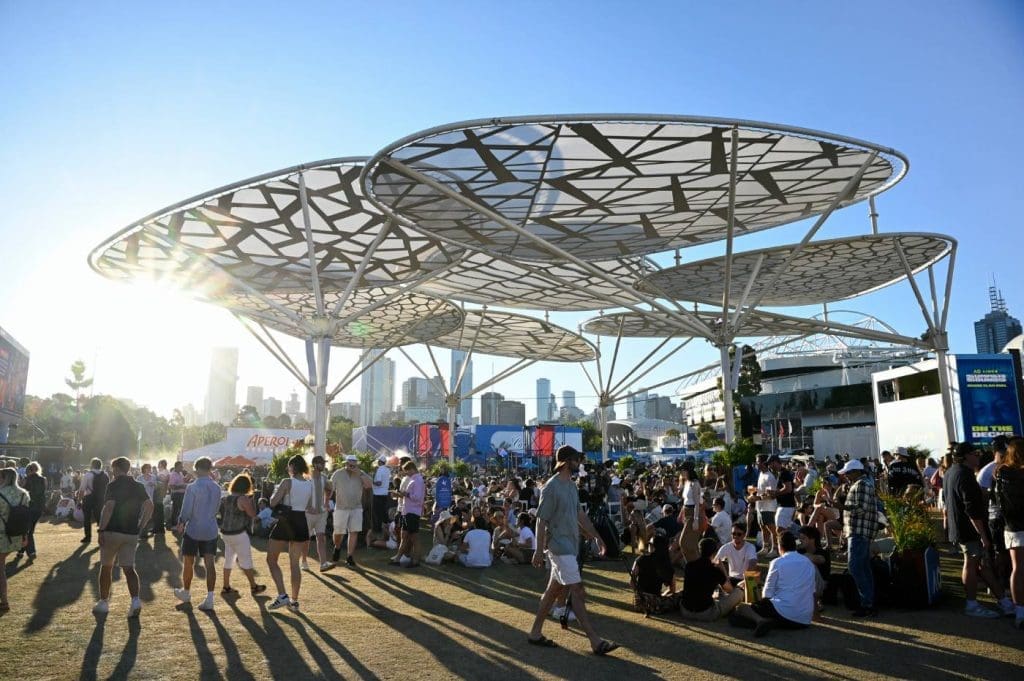
None of that growth happened by accident. Melbourne has deliberately built the Australian Open into something closer to a festival than a tournament, with the Birrarung Marr extension, the AO Live music programme and the Grand Slam Oval food precinct all designed to give visitors a reason to stay even when they’re not watching tennis. The economic flow-through reflects that ambition: economic impact studies estimated the event contributed AUD $387.7 million to the Victorian economy in 2020 alone, and more than AUD $2.71 billion over the preceding decade.
Why Is It Called the Happy Slam?
The Australian Open is nicknamed the “Happy Slam” because of its relaxed atmosphere, warm summer weather and the refreshed energy of players arriving at the start of a new season, a nickname coined by Roger Federer. The phrase stuck because it captures something the other three majors genuinely don’t have. Players arrive in January rested rather than worn down by a long season. They’re stepping off a European winter into a Melbourne summer, which is as much a physical lift as a mental one. The crowd is knowledgeable and loud without Wimbledon’s formality, and Tennis Australia has built a reputation for prioritising player welfare and hospitality over almost anything else on tour.
More than one player has described the tournament as something closer to a homecoming for those arriving from the Northern Hemisphere, a chance to reset before the year properly begins. That reputation hasn’t gone entirely unchallenged. Extreme heat events have tested players in brutal conditions, the 2022 Djokovic deportation cast a shadow over the tournament’s image, and scheduling complaints from players have surfaced more than once. None of that has dented the underlying numbers. The Australian Open remains the highest-attended Grand Slam in the world, and players still cite it, more often than not, as their favourite stop on tour. The nickname has earned its staying power.
Australian Open Records and Champions
Novak Djokovic has won the most Australian Open men’s singles titles with 10, all in the Open Era, while Margaret Court holds the all-time women’s record with 11 titles, spanning both the amateur and Open eras. Serena Williams holds the Open Era women’s record with 7 titles. The 2026 champions, Carlos Alcaraz and Elena Rybakina, continue a list of winners that now stretches back more than a century.
Men’s Singles Champions (Open Era, 1969 to 2026)
| Year | Champion | Nationality | Runner-up | Nationality | Score |
|---|---|---|---|---|---|
| 2026 | Carlos Alcaraz | Spain | Novak Djokovic | Serbia | 2-6, 6-2, 6-3, 7-5 |
| 2025 | Jannik Sinner | Italy | Alexander Zverev | Germany | 6-3, 7-6, 6-3 |
| 2024 | Jannik Sinner | Italy | Daniil Medvedev | Russia | 3-6, 3-6, 6-4, 6-4, 6-3 |
| 2023 | Novak Djokovic | Serbia | Stefanos Tsitsipas | Greece | 6-3, 7-6, 7-6 |
| 2022 | Rafael Nadal | Spain | Daniil Medvedev | Russia | 2-6, 6-7, 6-4, 6-4, 7-5 |
| 2021 | Novak Djokovic | Serbia | Daniil Medvedev | Russia | 7-5, 6-2, 6-2 |
| 2020 | Novak Djokovic | Serbia | Dominic Thiem | Austria | 6-4, 4-6, 2-6, 6-3, 6-4 |
| 2019 | Novak Djokovic | Serbia | Rafael Nadal | Spain | 6-3, 6-2, 6-3 |
| 2018 | Roger Federer | Switzerland | Marin Cilic | Croatia | 6-2, 6-7, 6-3, 3-6, 6-1 |
| 2017 | Roger Federer | Switzerland | Rafael Nadal | Spain | 6-4, 3-6, 6-1, 3-6, 6-3 |
| 2016 | Novak Djokovic | Serbia | Andy Murray | Great Britain | 6-1, 7-5, 7-6 |
| 2015 | Novak Djokovic | Serbia | Andy Murray | Great Britain | 7-6, 6-7, 6-3, 6-0 |
| 2014 | Stan Wawrinka | Switzerland | Rafael Nadal | Spain | 6-3, 6-2, 3-6, 6-3 |
| 2013 | Novak Djokovic | Serbia | Andy Murray | Great Britain | 6-7, 7-6, 6-3, 6-2 |
| 2012 | Novak Djokovic | Serbia | Rafael Nadal | Spain | 5-7, 6-4, 6-2, 6-7, 7-5 |
| 2011 | Novak Djokovic | Serbia | Andy Murray | Great Britain | 6-4, 6-2, 6-3 |
| 2010 | Roger Federer | Switzerland | Andy Murray | Great Britain | 6-3, 6-4, 7-6 |
| 2009 | Rafael Nadal | Spain | Roger Federer | Switzerland | 7-5, 3-6, 7-6, 3-6, 6-2 |
| 2008 | Novak Djokovic | Serbia | Jo-Wilfried Tsonga | France | 4-6, 6-4, 6-3, 7-6 |
| 2007 | Roger Federer | Switzerland | Fernando Gonzalez | Chile | 7-6, 6-4, 6-4 |
| 2006 | Roger Federer | Switzerland | Marcos Baghdatis | Cyprus | 5-7, 7-5, 6-0, 6-2 |
| 2005 | Marat Safin | Russia | Lleyton Hewitt | Australia | 1-6, 6-3, 6-4, 6-4 |
| 2004 | Roger Federer | Switzerland | Marat Safin | Russia | 7-6, 6-4, 6-2 |
| 2003 | Andre Agassi | USA | Rainer Schuettler | Germany | 6-2, 6-2, 6-1 |
| 2002 | Thomas Johansson | Sweden | Marat Safin | Russia | 3-6, 6-4, 6-4, 7-6 |
| 2001 | Andre Agassi | USA | Arnaud Clement | France | 6-4, 6-2, 6-2 |
| 2000 | Andre Agassi | USA | Yevgeny Kafelnikov | Russia | 3-6, 6-3, 6-2, 6-4 |
| 1999 | Yevgeny Kafelnikov | Russia | Thomas Enqvist | Sweden | 4-6, 6-0, 6-3, 7-6 |
| 1998 | Petr Korda | Czech Rep. | Marcelo Rios | Chile | 6-2, 6-2, 6-2 |
| 1997 | Pete Sampras | USA | Carlos Moya | Spain | 6-2, 6-3, 6-3 |
| 1996 | Boris Becker | Germany | Michael Chang | USA | 6-2, 6-4, 2-6, 6-2 |
| 1995 | Andre Agassi | USA | Pete Sampras | USA | 4-6, 6-1, 7-6, 6-4 |
| 1994 | Pete Sampras | USA | Todd Martin | USA | 7-6, 6-4, 6-4 |
| 1993 | Jim Courier | USA | Stefan Edberg | Sweden | 6-2, 6-1, 2-6, 7-5 |
| 1992 | Jim Courier | USA | Stefan Edberg | Sweden | 6-3, 3-6, 6-4, 6-2 |
| 1991 | Boris Becker | Germany | Ivan Lendl | Czechoslovakia | 1-6, 6-4, 6-4, 6-4 |
| 1990 | Ivan Lendl | Czechoslovakia | Stefan Edberg | Sweden | 4-6, 7-6, 5-2 ret. |
| 1989 | Ivan Lendl | Czechoslovakia | Miloslav Mecir | Czechoslovakia | 6-2, 6-2, 6-2 |
| 1988 | Mats Wilander | Sweden | Pat Cash | Australia | 6-3, 6-7, 3-6, 6-1, 8-6 |
| 1987 | Stefan Edberg | Sweden | Pat Cash | Australia | 6-3, 6-4, 3-6, 5-7, 6-3 |
| 1985 | Stefan Edberg | Sweden | Mats Wilander | Sweden | 6-4, 6-3, 6-3 |
| 1984 | Mats Wilander | Sweden | Kevin Curren | South Africa | 6-7, 6-4, 7-6, 6-2 |
| 1983 | Mats Wilander | Sweden | Ivan Lendl | Czechoslovakia | 6-1, 6-4, 6-4 |
| 1982 | Johan Kriek | South Africa | Steve Denton | USA | 6-3, 6-3, 6-2 |
| 1981 | Johan Kriek | South Africa | Steve Denton | USA | 6-2, 7-6, 6-7, 6-4 |
| 1980 | Brian Teacher | USA | Kim Warwick | Australia | 7-5, 7-6, 6-3 |
| 1979 | Guillermo Vilas | Argentina | John Sadri | USA | 7-6, 6-3, 6-2 |
| 1978 | Guillermo Vilas | Argentina | John Marks | Australia | 6-4, 6-4, 3-6, 6-3 |
| 1977 (Dec) | Vitas Gerulaitis | USA | John Lloyd | Great Britain | 6-3, 7-6, 5-7, 3-6, 6-2 |
| 1977 (Jan) | Roscoe Tanner | USA | Guillermo Vilas | Argentina | 6-3, 6-3, 6-3 |
| 1976 | Mark Edmondson | Australia | John Newcombe | Australia | 6-7, 6-3, 7-6, 6-1 |
| 1975 | John Newcombe | Australia | Jimmy Connors | USA | 7-5, 3-6, 6-4, 7-6 |
| 1974 | Jimmy Connors | USA | Phil Dent | Australia | 7-6, 6-4, 4-6, 6-3 |
| 1973 | John Newcombe | Australia | Onny Parun | New Zealand | 6-3, 6-7, 7-5, 6-1 |
| 1972 | Ken Rosewall | Australia | Mal Anderson | Australia | 7-6, 6-3, 7-5 |
| 1971 | Ken Rosewall | Australia | Arthur Ashe | USA | 6-1, 7-5, 6-3 |
| 1970 | Arthur Ashe | USA | Dick Crealy | Australia | 6-4, 9-7, 6-2 |
| 1969 | Rod Laver | Australia | Andres Gimeno | Spain | 6-3, 6-4, 7-5 |
Source: Australian Open honour roll (ausopen.com). No tournament held in 1986 due to the date change.
Women’s Singles Champions (Open Era, 1969 to 2026)
| Year | Champion | Nationality | Runner-up | Nationality | Score |
|---|---|---|---|---|---|
| 2026 | Elena Rybakina | Kazakhstan | Aryna Sabalenka | Belarus | 6-4, 4-6, 6-4 |
| 2025 | Madison Keys | USA | Aryna Sabalenka | Belarus | 6-3, 2-6, 7-5 |
| 2024 | Aryna Sabalenka | Belarus | Zheng Qinwen | China | 6-3, 6-2 |
| 2023 | Aryna Sabalenka | Belarus | Elena Rybakina | Kazakhstan | 4-6, 6-3, 6-4 |
| 2022 | Ashleigh Barty | Australia | Danielle Collins | USA | 6-3, 7-6 |
| 2021 | Naomi Osaka | Japan | Jennifer Brady | USA | 6-4, 6-3 |
| 2020 | Sofia Kenin | USA | Garbine Muguruza | Spain | 4-6, 6-2, 6-2 |
| 2019 | Naomi Osaka | Japan | Petra Kvitova | Czech Rep. | 7-6, 5-7, 6-4 |
| 2018 | Caroline Wozniacki | Denmark | Simona Halep | Romania | 7-6, 3-6, 6-4 |
| 2017 | Serena Williams | USA | Venus Williams | USA | 6-4, 6-4 |
| 2016 | Angelique Kerber | Germany | Serena Williams | USA | 6-4, 3-6, 6-4 |
| 2015 | Serena Williams | USA | Maria Sharapova | Russia | 6-3, 7-6 |
| 2014 | Li Na | China | Dominika Cibulkova | Slovakia | 7-6, 6-0 |
| 2013 | Victoria Azarenka | Belarus | Li Na | China | 4-6, 6-4, 6-3 |
| 2012 | Victoria Azarenka | Belarus | Maria Sharapova | Russia | 6-3, 6-0 |
| 2011 | Kim Clijsters | Belgium | Li Na | China | 3-6, 6-3, 6-3 |
| 2010 | Serena Williams | USA | Justine Henin | Belgium | 6-4, 3-6, 6-2 |
| 2009 | Serena Williams | USA | Dinara Safina | Russia | 6-0, 6-3 |
| 2008 | Maria Sharapova | Russia | Ana Ivanovic | Serbia | 7-5, 6-3 |
| 2007 | Serena Williams | USA | Maria Sharapova | Russia | 6-1, 6-2 |
| 2006 | Amelie Mauresmo | France | Justine Henin | Belgium | 6-1, 2-0 ret. |
| 2005 | Serena Williams | USA | Lindsay Davenport | USA | 2-6, 6-3, 6-0 |
| 2004 | Justine Henin | Belgium | Kim Clijsters | Belgium | 6-3, 4-6, 6-3 |
| 2003 | Serena Williams | USA | Venus Williams | USA | 7-6, 3-6, 6-4 |
| 2002 | Jennifer Capriati | USA | Martina Hingis | Switzerland | 4-6, 7-6, 6-2 |
| 2001 | Jennifer Capriati | USA | Martina Hingis | Switzerland | 6-4, 6-3 |
| 2000 | Lindsay Davenport | USA | Martina Hingis | Switzerland | 6-1, 7-5 |
| 1999 | Martina Hingis | Switzerland | Amelie Mauresmo | France | 6-2, 6-3 |
| 1998 | Martina Hingis | Switzerland | Conchita Martinez | Spain | 6-3, 6-3 |
| 1997 | Martina Hingis | Switzerland | Mary Pierce | France | 6-2, 6-2 |
| 1996 | Monica Seles | Yugoslavia | Anke Huber | Germany | 6-4, 6-1 |
| 1995 | Mary Pierce | France | Arantxa Sanchez Vicario | Spain | 6-3, 6-2 |
| 1994 | Steffi Graf | Germany | Arantxa Sanchez Vicario | Spain | 6-0, 6-2 |
| 1993 | Monica Seles | Yugoslavia | Steffi Graf | Germany | 4-6, 6-3, 6-2 |
| 1992 | Monica Seles | Yugoslavia | Mary Joe Fernandez | USA | 6-2, 6-3 |
| 1991 | Monica Seles | Yugoslavia | Jana Novotna | Czechoslovakia | 5-7, 6-3, 6-1 |
| 1990 | Steffi Graf | Germany | Mary Joe Fernandez | USA | 6-3, 6-4 |
| 1989 | Steffi Graf | Germany | Helena Sukova | Czechoslovakia | 6-4, 6-4 |
| 1988 | Steffi Graf | Germany | Chris Evert | USA | 6-1, 7-6 |
| 1987 | Hana Mandlikova | Czechoslovakia | Martina Navratilova | USA | 7-5, 7-6 |
| 1985 | Martina Navratilova | USA | Chris Evert Lloyd | USA | 6-2, 4-6, 6-2 |
| 1984 | Chris Evert Lloyd | USA | Helena Sukova | Czechoslovakia | 6-7, 6-1, 6-3 |
| 1983 | Martina Navratilova | USA | Kathy Jordan | USA | 6-2, 7-6 |
| 1982 | Chris Evert Lloyd | USA | Martina Navratilova | USA | 6-3, 2-6, 6-3 |
| 1981 | Martina Navratilova | USA | Chris Evert Lloyd | USA | 6-7, 6-4, 7-5 |
| 1980 | Hana Mandlikova | Czechoslovakia | Wendy Turnbull | Australia | 6-0, 7-5 |
| 1979 | Barbara Jordan | USA | Sharon Walsh | USA | 6-3, 6-3 |
| 1978 | Chris O’Neil | Australia | Betsy Nagelsen | USA | 6-3, 7-6 |
| 1977 (Dec) | Evonne Goolagong Cawley | Australia | Helen Gourlay | Australia | 6-3, 6-0 |
| 1977 (Jan) | Kerry Melville Reid | Australia | Dianne Fromholtz | Australia | 7-5, 6-2 |
| 1976 | Evonne Goolagong Cawley | Australia | Renata Tomanova | Czechoslovakia | 6-2, 6-2 |
| 1975 | Evonne Goolagong Cawley | Australia | Martina Navratilova | USA | 6-3, 6-2 |
| 1974 | Evonne Goolagong Cawley | Australia | Chris Evert | USA | 7-6, 4-6, 6-0 |
| 1973 | Margaret Court | Australia | Evonne Goolagong | Australia | 6-4, 7-5 |
| 1972 | Virginia Wade | Great Britain | Evonne Goolagong | Australia | 6-4, 6-4 |
| 1971 | Margaret Court | Australia | Evonne Goolagong | Australia | 2-6, 7-6, 7-5 |
| 1970 | Margaret Court | Australia | Kerry Melville | Australia | 6-1, 6-3 |
| 1969 | Margaret Court | Australia | Billie Jean King | USA | 6-4, 6-1 |
Source: Australian Open honour roll (ausopen.com). Margaret Court also won 7 women’s singles titles in the amateur era (1960 to 1968).
Men’s Doubles Champions (2017 to 2026)
| Year | Champions | Countries | Runners-up | Countries | Score |
|---|---|---|---|---|---|
| 2026 | Christian Harrison / Neal Skupski | USA / Great Britain | Jason Kubler / Marc Polmans | Australia | 7-6, 6-4 |
| 2025 | Harri Heliovaara / Henry Patten | Finland / Great Britain | Simone Bolelli / Andrea Vavassori | Italy | 6-7, 7-6, 6-3 |
| 2024 | Rohan Bopanna / Matthew Ebden | India / Australia | Simone Bolelli / Andrea Vavassori | Italy | 7-6, 7-5 |
| 2023 | Rinky Hijikata / Jason Kubler | Australia | Hugo Nys / Jan Zielinski | Monaco / Poland | 6-4, 7-6 |
| 2022 | Thanasi Kokkinakis / Nick Kyrgios | Australia | Matthew Ebden / Max Purcell | Australia | 7-5, 6-4 |
| 2021 | Ivan Dodig / Filip Polasek | Croatia / Slovakia | Rajeev Ram / Joe Salisbury | USA / Great Britain | 6-3, 6-4 |
| 2020 | Rajeev Ram / Joe Salisbury | USA / Great Britain | Max Purcell / Luke Saville | Australia | 6-4, 6-2 |
| 2019 | Pierre-Hugues Herbert / Nicolas Mahut | France | Henri Kontinen / John Peers | Finland / Australia | 6-4, 7-6 |
| 2018 | Oliver Marach / Mate Pavic | Austria / Croatia | Juan Sebastian Cabal / Robert Farah | Colombia | 6-4, 6-4 |
| 2017 | Henri Kontinen / John Peers | Finland / Australia | Bob Bryan / Mike Bryan | USA | 7-5, 7-5 |
Source: Australian Open honour roll (ausopen.com). Table shows the most recent ten years.
Women’s Doubles Champions (2017 to 2026)
| Year | Champions | Countries | Runners-up | Countries | Score |
|---|---|---|---|---|---|
| 2026 | Elise Mertens / Shuai Zhang | Belgium / China | Anna Danilina / Aleksandra Krunic | Kazakhstan / Serbia | 7-6, 6-4 |
| 2025 | Katerina Siniakova / Taylor Townsend | Czech Rep. / USA | Hsieh Su-Wei / Jelena Ostapenko | Taiwan / Latvia | 6-2, 6-7, 6-3 |
| 2024 | Hsieh Su-Wei / Elise Mertens | Taiwan / Belgium | Lyudmyla Kichenok / Jelena Ostapenko | Ukraine / Latvia | 6-1, 7-5 |
| 2023 | Barbora Krejcikova / Katerina Siniakova | Czech Rep. | Shuko Aoyama / Ena Shibahara | Japan | 6-4, 6-3 |
| 2022 | Barbora Krejcikova / Katerina Siniakova | Czech Rep. | Anna Danilina / Beatriz Haddad Maia | Kazakhstan / Brazil | 6-7, 6-4, 6-4 |
| 2021 | Elise Mertens / Aryna Sabalenka | Belgium / Belarus | Barbora Krejcikova / Katerina Siniakova | Czech Rep. | 6-2, 6-3 |
| 2020 | Timea Babos / Kristina Mladenovic | Hungary / France | Hsieh Su-Wei / Barbora Strycova | Taiwan / Czech Rep. | 6-2, 6-1 |
| 2019 | Samantha Stosur / Shuai Zhang | Australia / China | Timea Babos / Kristina Mladenovic | Hungary / France | 6-3, 6-4 |
| 2018 | Timea Babos / Kristina Mladenovic | Hungary / France | Ekaterina Makarova / Elena Vesnina | Russia | 6-4, 6-3 |
| 2017 | Bethanie Mattek-Sands / Lucie Safarova | USA / Czech Rep. | Andrea Hlavackova / Peng Shuai | Czech Rep. / China | 6-7, 6-3, 6-3 |
Source: Australian Open honour roll (ausopen.com). Table shows the most recent ten years.
Be Part of the Story: Attend the Australian Open 2027
The 2027 tournament, running from 17 to 31 January, continues a story that’s now 121 years old. Reading about that history is one thing. Standing in Rod Laver Arena under a Melbourne summer sky, with the crowd roaring on a tight third set, is another thing entirely. No broadcast captures the heat off the court, the noise bouncing off a roof that was the first of its kind in the world, or the particular energy of a city that builds its January around this tournament.
Keith Prowse Travel has been getting people to the world’s biggest sporting events for 50 years, and our Australian Open packages are built around the access that matters most: premium seating, guaranteed tickets, and accommodation close enough to the precinct that you’re never racing the clock. If the history of the Happy Slam has you thinking about seeing the next chapter for yourself, our Australian Open 2027 packages are the place to start.