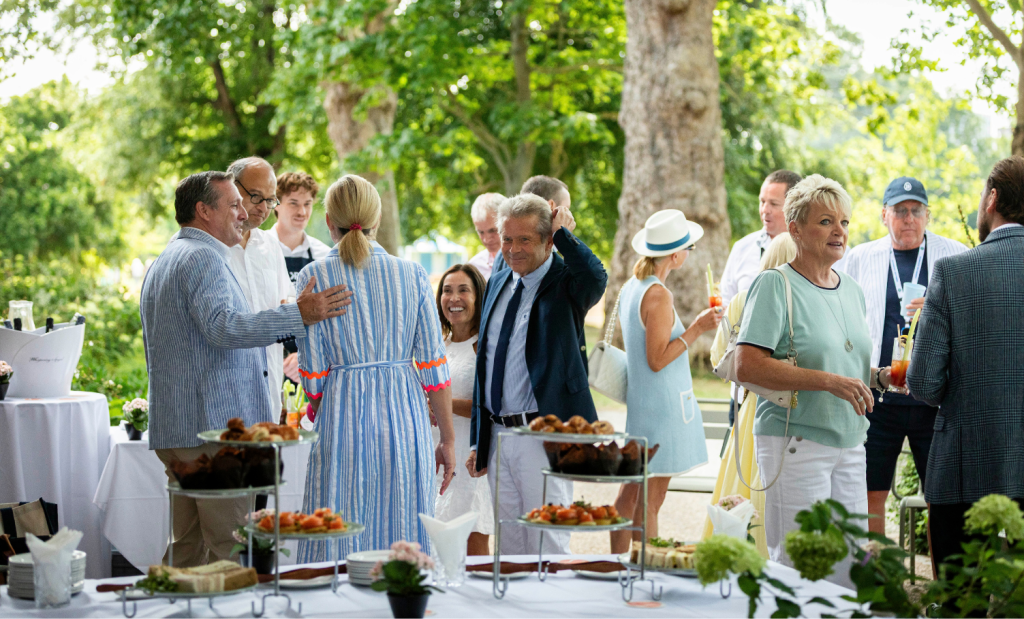
Strawberries and cream have been served to spectators at Wimbledon since the very first Championships in 1877, and the tradition has never once lapsed since. The timing is no accident: The Championships fall squarely at the peak of the short English strawberry season, when home-grown fruit is at its very best. Long before Wimbledon existed, the pairing itself was already a fashionable summer luxury among the Victorian upper classes who attended garden parties and early lawn tennis matches.
Why strawberries and cream at Wimbledon?
The Championships began in July 1877, exactly when English strawberries ripen. The natural season for English-grown fruit runs only a few weeks across June and July, and Wimbledon has always fallen inside that window.
Before refrigeration, strawberries had to be eaten on the day they were picked, or close to it. That made them rare, expensive and, for a few weeks each summer, fashionable in a way most fruit never was.
Fresh berries were a status symbol among the upper-class spectators who attended garden parties and early lawn tennis. Serving strawberries and cream at a tournament like this one signalled the occasion, not just the season.
As crowds grew through the following decades, there was also a practical case for the pairing. A simple, cold snack that could be served quickly, in large numbers, to an outdoor summer audience, was exactly what a growing tournament needed.
Some historians trace the pairing back further still, to 1509, when Cardinal Wolsey is said to have served strawberries and cream to Henry VIII.
None of that quite explains why the tradition has lasted 150 years, though. The real answer is refrigeration, or the lack of it. Wimbledon’s strawberries were never a marketing choice, but the only fruit that could be picked, sold and eaten within the tournament’s own short window, and by the time refrigeration made that unnecessary, the tradition had already set.
The tournament itself gives some credit to Henry Jones, an early director of the All England Club, said to have chosen strawberries for their seasonal timing and their reputation as a refined, understated treat. The logic behind that choice has never really changed: strawberries and cream cost little to prepare, need no cooking, and travel well from a tray to a seat on the Hill.
How many strawberries does Wimbledon get through?
Hugh Lowe Farms, based near Maidstone in Kent, has supplied Wimbledon’s strawberries for close to three decades, and remains its sole supplier. The variety is Malling Centenary, a Grade 1 English strawberry bred specifically for flavour and size, small enough to sit neatly in the individual pots Wimbledon serves them in.
The daily process is tight by design. Pickers start at around 4am each morning of The Championships. The fruit is loaded onto trucks and delivered to the grounds that same morning, in time to be served to spectators the same day it was picked.
Hugh Lowe Farms has quoted a consistent figure across recent years: around 30 tonnes of strawberries supplied to Wimbledon across the fortnight. Set against the farm’s own annual production of several thousand tonnes, it is a small order by volume and an outsized one by reputation.
The farm itself has grown fruit in Kent since 1893, and is still run by the same family five generations later. Managing director Marion Regan has described the Wimbledon order as the most nerve-wracking two weeks of her farming year, given how reliant the crop is on weather in the days beforehand. Bees do much of the early work: managed hives across the farm pollinate the plants that will eventually supply the tournament, months before a single berry reaches SW19.
What do strawberries and cream cost at Wimbledon?
The All England Club has deliberately kept the price low, and for a long stretch, kept it frozen entirely. From 2010 to 2024, a portion of strawberries and cream cost £2.50, unchanged for fourteen straight years while almost everything else at the grounds got more expensive around it.
That policy is the story here more than the figure itself. Keeping the tournament’s signature snack affordable, even as hospitality and championship-wide costs climbed, has been a deliberate choice by the AELTC, not an accident of the market.
The price has since moved: £2.70 in 2025, and £2.85 as of the 2026 Championships, still for a portion of ten strawberries and cream. Expect it to move again by the time you are reading this, but expect it to stay modest relative to almost everything else sold on the grounds, where a glass of champagne or a plate from one of the grounds restaurants runs to many times that figure.
Where to find them at the grounds
Strawberries and cream are sold across the grounds rather than at a single stand, and they are available to every ticket type, including ground pass holders on the outside courts. The classic serving is a punnet with its own small pot of cream, eaten standing, walking between courts, or settled on Henman Hill with the big screen in view.
In the Debenture Lounge restaurants and bars, they are also available as part of table service, a more sit-down version of the same tradition, brought to you rather than collected from a stall.
Wherever you buy them, the format never changes. There is no premium version sold on the grounds, and everyone at Wimbledon, from a debenture holder to a ground pass visitor on the Hill, eats the same punnet and the same small pot of cream.
A reserved seat on Centre Court or No.1 Court still admits you to the wider grounds, so the tradition is available whichever ticket you are holding on the day.
Pimm's: the other Wimbledon tradition
If strawberries and cream are Wimbledon’s food tradition, Pimm’s is its drink. Pimm’s No.1 Cup is a gin-based liqueur, traditionally served with lemonade, mint, cucumber, orange and strawberry, poured into a tall glass over ice.
Pimm’s predates Wimbledon by more than fifty years. It was invented in 1823 by James Pimm, an oyster bar owner in the City of London, as a gin-based digestive aid to accompany the shellfish he served. The tankard it was poured in was known as a No. 1 Cup, which is where the name comes from.
The pairing with Wimbledon rests on the same summer-garden associations as the strawberries themselves, and on decades of presence at the grounds. It has become as fixed a part of a day at The Championships as the tennis on court.
Pimm’s is sold across the grounds, including on Henman Hill, in the Debenture Lounges, and at the bars serving the outside courts. The price has climbed alongside everything else: a glass cost around £13.45 as of the 2026 Championships, up from £12.25 the year before, and it is usually served in a reusable cup that spectators are encouraged to keep or return for a small deposit.
The brand has changed hands several times since 1823, and has been owned by Diageo since 1997, but the recipe has stayed close to the original idea.
The fortnight moves a genuinely large volume. More than 330,000 glasses of Pimm’s were sold across the 2023 Championships alone, and that number has grown in the years since. Together with the strawberries, it means the two traditions are consumed by almost every visitor who passes through the gates, whichever court they are ticketed for.
Making a day of it
A day at Wimbledon has its own rhythm: strawberries mid-afternoon, a Pimm’s on the Hill between matches, the walk from one court to another with the whole grounds to explore along the way. The traditions are not a break from the tennis, something to fit in around the matches. They are part of the day itself, as central to a Wimbledon visit as anything played on court.
Our packages for The Championships, Wimbledon include a reserved show court seat with premium access, alongside central London accommodation, so the day is arranged before you arrive rather than pieced together on it. If that sounds like the way you want to spend a day at The Championships, then get in touch with our Sports Travel Experts.