


In this story
- Albert Park Circuit at a Glance
- Where Is the Albert Park Circuit?
- Is Albert Park a Street Circuit?
- From Adelaide to Albert Park: A Short History
- A Lap of Albert Park: Corner by Corner
- Overtaking at Albert Park: Passing Zones and Straight Mode
- Where to Watch: Grandstands, Mounds and Precincts
- Frequently Asked Questions
For fifty-one weeks of the year, Aughtie Drive and Lakeside Drive are just park roads. Melburnians run laps of the lake on them, cyclists commute along them, and dog walkers cross them without a second thought. Then, for one week in March, they become the fastest street circuit on the Formula 1® calendar, closed off, fenced in, and lined with grandstands where joggers usually pass.
If you’re planning a trip to the Australian Grand Prix, this guide covers the track itself: every corner, where the racing actually happens, and where to watch it from. We’ve stood trackside at Albert Park more times than we can count, and we’ve built this guide the way we’d talk you through it in person, the version we’d give a friend who’s never been before and wants to know exactly where to stand, and why.
Albert Park Circuit at a Glance
- Circuit type: semi-permanent street circuit on public park roads
- Location: Albert Park, around 3 km south of Melbourne’s CBD
- Length: 5.278 km
- Corners: 14
- Race distance: 58 laps / 306.124 km
- Lap record: 1:19.813, Charles Leclerc (2024)
- Pole record: 1:15.096, Lando Norris (2025), averaging over 250 km/h
- First Melbourne race: 1996
Where Is the Albert Park Circuit?
Albert Park sits around 3 km south of Melbourne’s CBD, circling Albert Park Lake between St Kilda and Port Phillip Bay. It’s one of the more accessible Grand Prix™ venues on the calendar precisely because it sits inside the city rather than out on its edge, which is part of why race week feels like it takes over Melbourne rather than sitting apart from it. The precinct is well served by tram and a short taxi ride from the city centre.
Is Albert Park a Street Circuit?
Albert Park is a semi-permanent street circuit, built each year on public roads, mainly Aughtie Drive and Lakeside Drive, with a short detour through the Lakeside Stadium car park. The build goes up in the weeks before the race and comes down again just as quickly once it’s over, an operation that’s become one of the more impressive logistical feats on the F1® calendar in its own right. Despite running on public roads, the surface is smoother than most street circuits, closer in feel to a permanent track, which is one reason drivers tend to speak well of it compared with tighter street layouts elsewhere.
The part most visitors don’t expect: outside race week, you can walk, run or cycle the exact lap the cars take. No other circuit on the calendar offers that kind of everyday access to the racing surface. If you’re in Melbourne outside of Grand Prix™ week, it’s worth the detour, if only to stand on a corner you’ve watched on television and realise how much smaller it feels in person.
From Adelaide to Albert Park: A Short History
Australia’s Formula 1® story starts in Adelaide, where the first World Championship Australian Grand Prix ran in 1985. The Adelaide street circuit held the race for a decade before the Kennett Government struck a deal in 1993 to bring it to Melbourne, a decision that split opinion at the time but has shaped three decades of the sport’s calendar since. Melbourne’s first race followed in 1996, a weekend best remembered for Martin Brundle’s spectacular Turn 3 crash, when his Jordan launched off the back of Johnny Herbert’s Sauber and barrel-rolled down the straight. Brundle famously climbed out, jogged back to the pits, and took the restart in the spare car, a story that’s become part of the circuit’s folklore and still gets told to first-time visitors nearly thirty years on.
The circuit itself changed shape in 2021, when seven corners were reprofiled and the old Turn 9/10 chicane was removed entirely. Taking the chicane out created a flat-out run of more than 1.3 km from Turn 8 all the way to the entry of what is now the fast Turn 9, the longest full-throttle stretch on the lap. That single change cut the lap from 16 corners to 14 and made Albert Park Grand Prix Circuit noticeably faster, shifting where the overtaking chances happen and giving the cars a genuine top-speed test in the middle sector. 2026 marked 30 years of Formula 1® in Melbourne, a milestone that quietly underlines how much the event has grown since that first, slightly chaotic race.
For the full story, including every winner since 1928, read our History of the Australian Grand Prix article. And for the drivers whose names now sit on the grandstands you’re about to read about, see our Australian F1® Drivers article.
A Lap of Albert Park: Corner by Corner
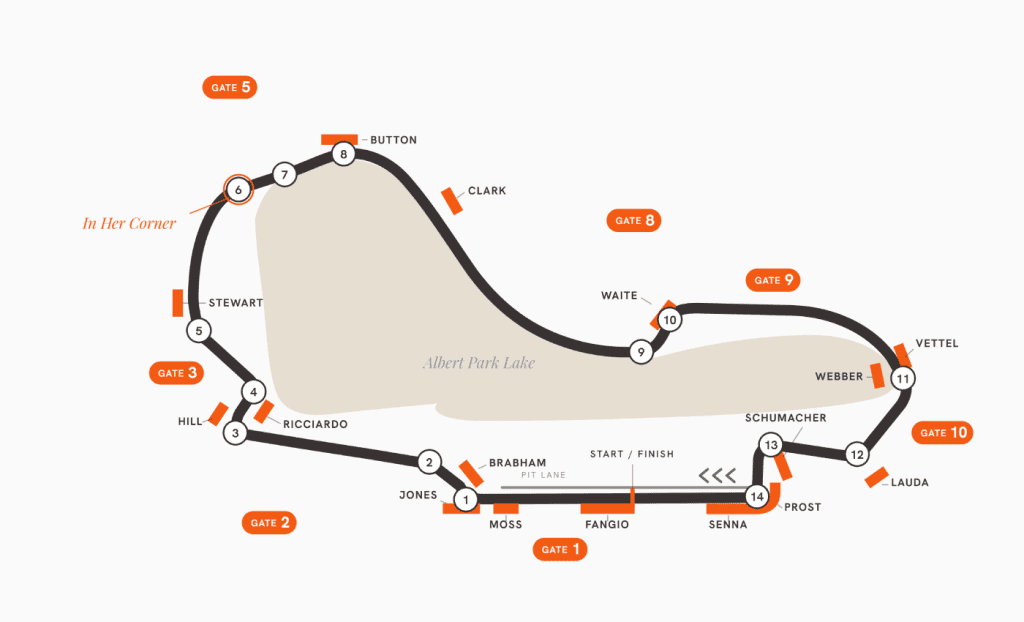
Albert Park Grand Prix Circuit Map
Turns 1 and 2 open the lap with the heaviest braking zone on the circuit, straight off the joint start and finish line. It’s where lap-one chaos tends to happen; more than one Australian Grand Prix has been decided in the first few seconds, cars arriving three and four wide into a corner that doesn’t really have room for it. The Jones and Brabham grandstands sit opposite each other here, giving you a side-on view of the entire opening skirmish.
Turn 3 is the circuit’s prime overtaking zone, a hard braking point after a long run from Turn 2. It’s watched from the Ricciardo grandstand, positioned on the infield between Turns 3 and 4, close enough to hear the brakes.
From there the lap swings into the lakeside run, past Turn 5 and the technical Turn 6, before opening out into a longer, faster middle sector, the part of the lap where Albert Park stops feeling like a park circuit and starts feeling like a proper racetrack.
Turn 6 carries a name you won’t find on any other Formula 1® circuit map: In Her Corner. In 2026 Albert Park became the first F1® venue in the world to dedicate a corner to women in the sport, honouring Laura Mueller, Haas’s race engineer and the first full-time female race engineer in Formula 1®, and Hannah Schmitz, Red Bull’s head of race strategy. The initiative, a partnership between Engineers Australia and the Australian Grand Prix Corporation, launched to coincide with International Women’s Day, which in 2026 fell on race day itself. The name is a historic addition to the circuit, and Turn 6 now has its own Engineers Australia grandstand and innovation hub alongside it. It’s a genuinely distinctive piece of circuit history, and one worth knowing before you arrive. For more on the women shaping Formula 1® today, read our Women in F1® article.
The middle of the lap is where Albert Park shows its speed. Cars run close to flat out from Turn 6 through to the fast Turns 9 and 10, the sweeping double corner that follows the stretch where the old chicane used to sit. It’s the section where the top speed and lap records tend to fall, and it’s watched from the Waite grandstand, named for Arthur Waite, winner of the very first Australian Grand Prix back in 1928.
Turns 11 and 12 form a high-speed chicane that tests both downforce and nerve, a place where a car that’s been planted through the middle sector can suddenly feel loose. From there the lap settles into its final sequence: Turns 13 and 14, tightening back down before the pit straight. It’s a less forgiving finish than it looks on a map, tighter than the speed of the preceding sector suggests, and a driver who’s carried too much confidence out of Turns 9 and 10 can find themselves running wide right here. As former F1® driver and analyst Jolyon Palmer has pointed out, Albert Park Grand Prix Circuit is not easy to overtake on. The corners reward a car that’s already fast rather than gifting easy passes, which is part of why the passing zones matter so much.
Overtaking at Albert Park: Passing Zones and Straight Mode
Three spots do most of the overtaking work at Albert Park: the braking zone into Turn 3 off the long run from Turn 2, into Turn 1 at the start and on restarts, and into Turn 11 after the flat-out lakeside stretch. Each is tied to a grandstand that watches it directly, so if overtaking is what you’re there to see, those are the three spots worth building your day around.
The honest caveat still applies. It’s not an easy circuit to pass on, and a small advantage in the corner rarely translates into an easy move down the following straight. Albert Park rewards patience over ambition, a car that can out-brake its rival cleanly rather than one that simply out-drags it down the next stretch of tarmac.
Through 2025, overtaking at Albert Park was assisted by DRS across four zones and two detection points, among the most of any circuit on the F1® calendar. From 2026, DRS no longer exists anywhere in Formula 1®. It’s been replaced by Straight Mode, part of the sport’s new active aerodynamics system, and a separate Overtake Mode for closing a gap. At Albert Park, there are five Straight Mode zones: the pit straight, Turns 2 to 3, Turns 5 to 6, Turns 8 to 9, and Turns 10 to 11. Overtake Mode has its own detection point just after Turn 13, with activation available into the final corner.
In plain terms, Straight Mode flattens the car’s front and rear wings on the straights to cut drag and lift top speed, and every driver can use it, every lap, regardless of who’s ahead of them. Overtake Mode is the part that still rewards a chasing driver specifically, giving them an extra burst of deployable energy when they’re within a second of the car in front. It’s a genuinely different way of watching a race compared to the DRS era, and Albert Park’s tight, technical layout makes it one of the better circuits to see how the new system actually plays out, particularly in that run from the lakeside stretch into Turn 11, where the extra energy can make or break a move.
Where to Watch: Grandstands, Mounds and Precincts

Every grandstand at Albert Park watches a different piece of the story, so the right seat depends entirely on what you actually want to see happen in front of you, whether that’s the opening-lap chaos, the circuit’s fastest corner, or the run to the flag.
| Grandstand | Corner / Section | What You See |
|---|---|---|
| Fangio | Main straight, start/finish | The start, pit stops, the chequered flag |
| Piastri (new from 2026) | Main straight, opposite the pits | Start-line launch, pit lane, home-crowd atmosphere |
| Jones / Brabham | Turns 1–2 | Lap-one braking and first-corner incidents |
| Hill | Turns 3–4 | A key overtaking stretch |
| Ricciardo | Turns 3–4 | The circuit’s prime overtaking zone |
| Stewart | Turn 5 exit | Cars taken almost flat, close to the track |
| In Her Corner (Engineers Australia) | Turn 6 | The circuit’s only named corner, with the innovation hub alongside |
| Button / Clark | Turn 8 | Full-throttle running, one of the fastest points on the lap |
| Waite | Turns 9–10 | The fast double corner, lake and skyline behind you |
| Vettel / Webber | Turn 11 | Heavy braking after the flat-out lakeside run |
| Lauda | Turn 12 | Melbourne skyline backdrop, gravel run-off in view |
| Schumacher / Senna / Prost | Turns 13–14 | Final corners, pit lane entry, the run to the flag |
A Park Pass gives you the freedom to move around the circuit and watch from a series of elevated mounds rather than a fixed seat. It’s a genuinely good way to experience Albert Park, particularly if you want to see more than one section of the track across a day rather than committing to a single view, and it tends to suit first-time visitors who aren’t yet sure which corner will end up being their favourite. Prime mounds, including Brocky’s Hill, named after legendary Australian driver Peter Brock, fill quickly, so if you’re chasing a specific view, early arrival matters, and it’s worth having a backup spot in mind if your first choice is already packed.
Beyond the racing, Albert Park is organised into festival precincts, each with its own character and its own reason to visit. Melbourne Junction hosts driver arrivals along the Melbourne Walk, one of the few times all weekend you’ll see the drivers up close outside the car. Motorsport Straight puts you close to the support-category paddocks, good if you want to see the machinery rather than just watch it fly past. Lakeside is home to the evening concerts, which we cover in full in our Australian Grand Prix Entertainment article. Pit Stop Park rounds out the family and interactive zones, built for a slower pace between sessions.
For guests of Keith Prowse Travel, the grandstand you choose shapes the whole weekend. A seat in the Jones grandstand, for instance, puts you right on the heaviest braking zone on the lap, close enough that you’ll feel the first-corner tension build every single lap, from the formation lap right through to the chequered flag. Our team can talk you through which stand suits how you want to watch the race, and what’s included in each package, via our FORMULA 1 MOËT & CHANDON AUSTRALIAN GRAND PRIX 2027 packages and tickets page.
Frequently Asked Questions
How many laps is the Australian Grand Prix?
58 laps, covering 306.124 km, run to a two-hour time limit. The 2023 race, stopped by three red flags, is a reminder that Albert Park doesn’t always run to a clean finish.
How long does the race last?
Usually around 90 minutes from lights out to chequered flag, though incidents, safety cars and red flags can extend that considerably.
What is the lap record at Albert Park?
1:19.813, set by Charles Leclerc in 2024. It’s still standing, and the 2026 season’s new regulations, aimed at closer racing rather than outright pace, mean it’s likely to hold for a while yet.
Can you visit Albert Park circuit outside the Grand Prix™?
Yes, outside the event period, the roads that make up the circuit function as ordinary public parkland, open to walk, run or cycle whenever you like, no ticket required.
Are the corners at Albert Park named?
One of them is. Turn 6 is In Her Corner, named in 2026 for engineers Laura Mueller and Hannah Schmitz, and it remains the only named corner on the circuit. Albert Park’s tradition runs through its grandstands instead, which carry the names of world champions and motorsport pioneers from Fangio and Senna to Brabham, Jones, Waite, Webber, Ricciardo and, since 2026, Oscar Piastri. Read more about the Australians among them in our Australian F1® Drivers article.
Plan Your FORMULA 1 MOËT & CHANDON AUSTRALIAN GRAND PRIX 2027
The circuit rewards knowing where to stand before you arrive. Whichever grandstand you choose, the difference between watching the race and really understanding it usually comes down to what’s happening in front of your seat, and knowing what to look for in that section of track. View our FORMULA 1 MOËT & CHANDON AUSTRALIAN GRAND PRIX 2027 packages for grandstand and hospitality options with Keith Prowse Travel.


