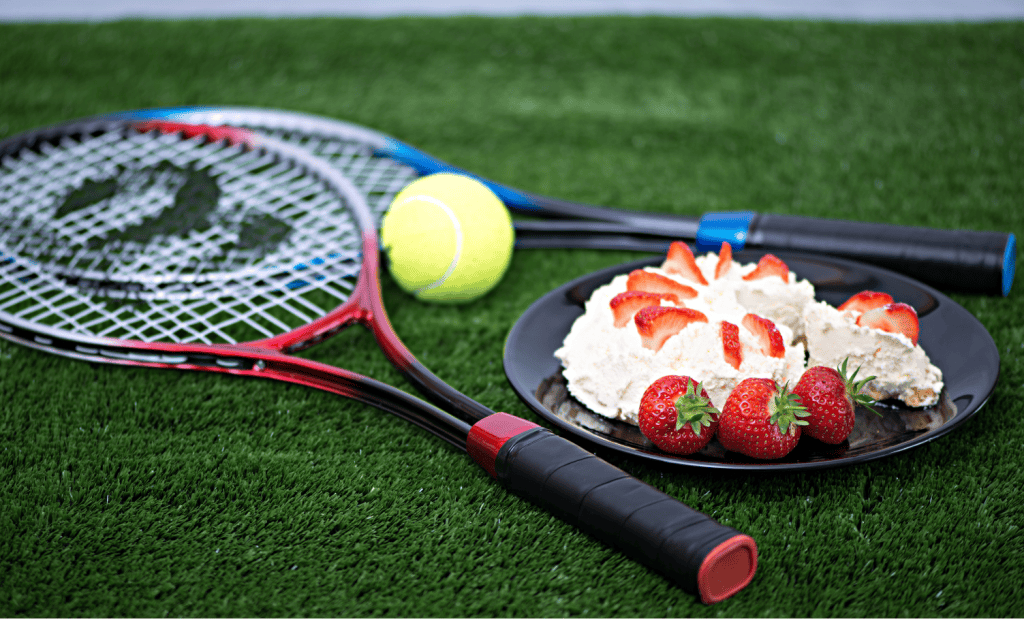
There is no official dress code for Wimbledon spectators, and no dress rule appears anywhere on the ticket itself. Smart casual is the general expectation across the grounds. The standard rises noticeably in the Debenture Lounges and hospitality areas, and the Royal Box enforces one firm rule of its own: a jacket and tie for men. The players, by contrast, are bound by one of the strictest dress codes in professional sport, an entirely separate set of rules from anything a spectator needs to think about.
Is there a dress code for Wimbledon spectators?
There is no official rule for general admission. You will not be turned away for wearing the wrong colour or cut of clothing, within reason.
The All England Club will refuse entry for a short list of items: ripped or distressed denim, beachwear, sportswear, running vests, flip-flops, and dirty trainers. Beyond that, the choice is yours.
Most spectators dress the way they would for a summer wedding: smart, comfortable, and suited to standing and sitting outdoors for most of a day. That comparison is the easiest way to calibrate an outfit for Wimbledon, and it holds whether you are in the ground pass queue or a Centre Court seat.
Nobody checks outfits at the gate the way a nightclub might. The banned items exist to stop a handful of specific problems, not to police fashion generally, which is why the list above is short and the rest of the guidance below is really about comfort and convention rather than rules.
Dress expectations by area, from the grounds to the Royal Box
| Where | Expectation |
|---|---|
| Grounds and outside courts | Anything except the banned items. Comfortable shoes matter more than smart ones. |
| Centre Court and No.1 Court | Smart casual. Not enforced, but the norm, and more so in the second week. |
| Debenture Lounges and restaurants | Smart casual. No jacket or tie required. Trousers and a collared shirt recommended for men. |
| Hospitality suites | A jacket is expected. |
| Royal Box | Jacket and tie required for men. Invitation only. |
On the grounds and the outside courts, comfort matters more than polish. You will be on your feet for hours, on grass and gravel, moving between courts. Centre Court and No.1 Court raise the bar slightly, not by rule but by convention, and that convention tightens further in the second week as the tournament builds toward its finals.
The Debenture Lounges keep to smart casual rather than formal wear, though a collared shirt and proper trousers read better than anything too relaxed. Hospitality suites expect a jacket. The Royal Box is the one place with an enforced rule: jacket and tie for men, and an invitation is the only way in.
Nothing in this table is written down as a formal condition of entry outside the Royal Box itself. It reflects what regular attendees actually wear, and what will make you feel comfortably dressed rather than conspicuously under or overdressed in each part of the grounds.
What women wear to Wimbledon
Midi and summer dresses, tailored jumpsuits and smart co-ords all work well. A light cardigan, blazer or trench covers the temperature swing between an early match and an evening one. Flats, wedges or a low block heel are the practical footwear choice, since stilettos sink into grass and there is a lot of walking between courts.
Two practical points are worth making. The day is long and mostly outdoors, so an outfit that looks right at 1pm needs to still feel right at 8pm too. And white is entirely fine for spectators to wear, whatever some visitors assume. It is reserved for the players on court, but is an option for the crowd too.
A layer that can come off and go back on without ruining the look of the outfit underneath is worth more than any single statement piece. Temperatures at Wimbledon in late June and early July regularly swing 10 degrees or more between an early match and the evening session, and there is nowhere convenient to store a bulky jacket once you are seated. A cardigan or light blazer solves that problem far better than a coat, which is usually one layer too many for the middle of the day.
What men wear to Wimbledon
Chinos or linen trousers with an open-collar shirt or polo cover most of a day comfortably. A lightweight blazer works if the weather turns, and can come off if it does not. Loafers, brogues or clean leather trainers are the safer footwear choices. A tie is only necessary for the Royal Box or a hospitality suite.
Ralph Lauren has been Wimbledon’s official outfitter since 2006, which is part of why the polo shirt reads as the safe, expected default rather than an overly casual one.
On denim: dark, unripped jeans with a smart shirt will not get you turned away at the gate. They are, however, the least comfortable choice on a hot day, and they read as noticeably casual in the lounges.
A polo shirt in a plain colour, paired with chinos and a decent pair of loafers, is close to a uniform among male spectators for a reason. It reads as put together without trying too hard, and it photographs well if you end up on one of the big screens between matches. None of it needs to be new or expensive. The look works because it is simple, not because of the label attached to it.
Hats, shoes and the weather
Hats. The answer is not whether to wear one, but which one. A large brim blocks the view of whoever is sitting behind you, and is quietly resented on the show courts. A foldable Panama or a cap is the practical choice: worn around the grounds, removed once you are in your seat.
Shoes. Grass, gravel, and a great deal of walking between courts define the day more than any dress code does. Comfort should come first, smartness second. Heels sink into the grass. Flip-flops are banned outright. Clean trainers are fine on the grounds, and acceptable in the lounges if they are smart rather than sporty.
Weather. Late June and early July in London can deliver 28 degrees and a downpour within the same afternoon. A light layer and a compact umbrella are worth carrying regardless of the forecast. Because Centre Court and No.1 Court both have retractable roofs, play continues through rain, which means you will be sitting through whatever the sky does that day rather than waiting it out inside.
On the outside courts, it is a different story: rain there stops play outright, so a compact umbrella earns its place in the bag even on a day that starts clear.
What not to wear
Two short lists cover everything worth knowing before you pack.
Banned outright: ripped denim, beachwear, sportswear, running vests, flip-flops, dirty trainers, and anything offensive or overly revealing.
Ill-advised, though not banned: large hat brims on the show courts, stilettos, football shirts, loud logos, and full black on a hot day.
Nothing else on this list will get you turned away at the gate. Everything above it is either an automatic refusal or a genuine comfort problem once you are inside.
Why the players wear all white
Competitors must be dressed almost entirely in white. Not off-white, not cream. The rule is specific and strictly applied.
A single trim of colour, no wider than 10mm, is permitted at the neckline or cuffs. Caps, headbands, wristbands, socks and shoes must all be white. Any undergarment visible during play, including through perspiration, must be white too.
One exception was added in 2023: women players may wear solid mid or dark coloured undershorts, provided they do not extend past the outer shorts or skirt.
The tradition dates to the Victorian era, when visible sweat was considered improper and white showed it least. The All England Club has maintained the rule since, partly out of tradition and partly so that players stand out for their tennis and nothing else.
It remains one of the strictest dress codes in professional sport. Players have been sent off court to change over the years for undergarments, shoe soles or headbands judged not white enough, and the rule is checked closely on the show courts in particular, where the cameras and the crowd both notice everything.
Bags and what you can bring in
One bag per person is allowed, within the AELTC’s size limit of 40cm x 30cm x 30cm, roughly the size of a small cabin bag. Anything larger will not be permitted onsite, and there is no cloakroom at the gates to leave it in, so it pays to check before you travel rather than at the entrance. For the full list of prohibited items, wimbledon.com‘s own guidance is the right place to check, since it is updated as rules change.
You now know what to pack for a day at The Championships. The remaining question is where you will be sitting, and that is what our Wimbledon packages settle. Our Wimbledon package page has the detail.